
Passive filters
Harmonic currents occur in electrical power systems due to nonlinear loads such as computers, frequency converters, and UPS systems. Harmonic currents cause, for example, increased losses and malfunctions in electrical equipment. A filter bank is needed when the amount of a specific harmonic (for example, the 5th or 7th) in the network is too high.
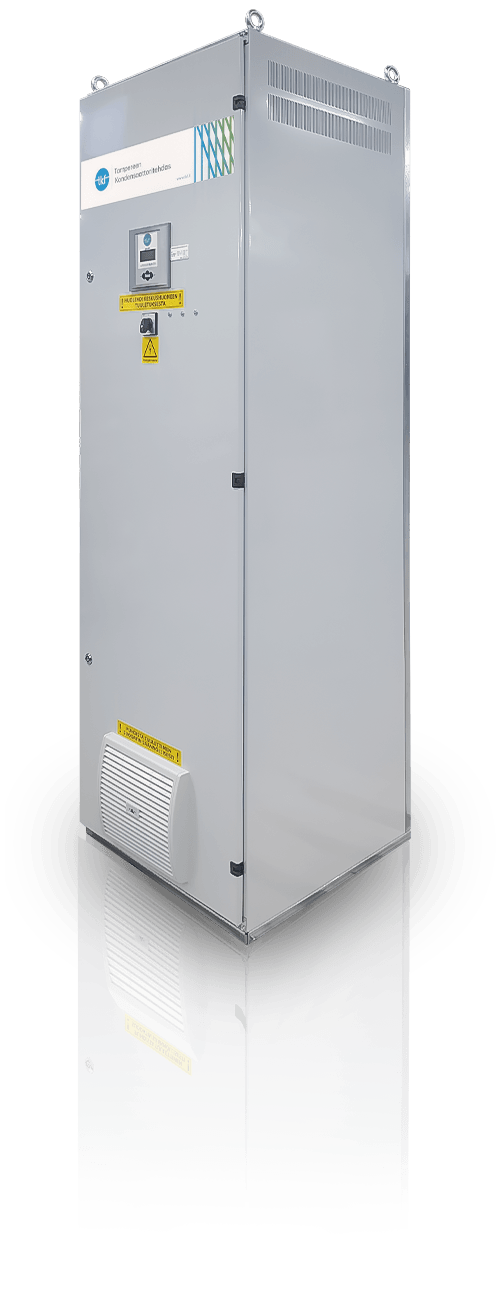
Harmonic filtering
As its name suggests, a filter bank is designed for electricity networks with high levels of harmonics. They improve the power quality by filtering out harmonics of a specific order (for example, the 5th). In addition, the filter bank improves the power factor in the same way as a detuned capacitor bank. When the harmonics are moderate, a less expensive detuned capacitor bank may be a more economical option than a filter bank. If, for example, the 5th and 7th harmonics appear in the network, the solution is to install a properly dimensioned filter bank for each harmonic. Any suspicion of high harmonic distortion should be verified through measurements.
Most commonly used
passive filters
Features
– 5th-harmonic filter (250 Hz), 150 kVAr – 300 kVAr
– 7th-harmonic filter (350 Hz), 150 kVAr – 300 kVAr
– Cabinet dimensions: 800 x 600 x 2000 (L x W x H)
– Voltage, for example, 400 V or 690 V
– Temperature range: 0–35°C
Harmonics
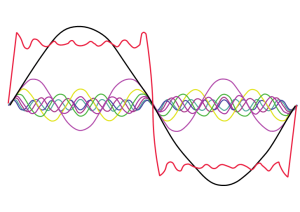
The ideal electrical current and voltage waveforms are sinusoidal (BLACK). Some electrical devices cause distortions in the sinusoidal waveform of the network. These distortions, shown in the blue curve, are called harmonics. Harmonics are multiples of the fundamental frequency: (DIFFERENT COLOURS). Harmonics add to the fundamental wave, causing a distorted sinusoidal wave (RED).
TKF's solutions are used at thousands of sites, ranging from office buildings to industrial facilities
Needs range from standard reactive power compensation to demanding applications that are critical to society. Hospitals (such as Tampere University Hospital and Satakunta Central Hospital in Finland), the Finnish Defence Forces, infrastructure projects (Helsinki Airport and the Helsinki metro), industry, real estate companies (VVO, Senate Properties), and electrical installations.