Neutral earthing reactor
A neutral earthing reactor is an earth-fault protection component in a power system designed to limit the earth-fault current and ensure the safe and selective operation of the system. The reactor is connected to the neutral point of a transformer or switching station, and it compensates for earth-fault currents in the network.
Neutral earthing reactors in 110 kV and 400 kV systems:
- Reduce the earth-fault current to a safe level
- Enable selective and rapid protective relay operation
- Reduce the voltage and thermal loads caused by arcing earth faults
- Improve network availability and security
- High-voltage neutral earthing reactors are a critical component of the transmission grid’s protection system, ensuring that the grid remains stable, even during disturbances.
Battery operation
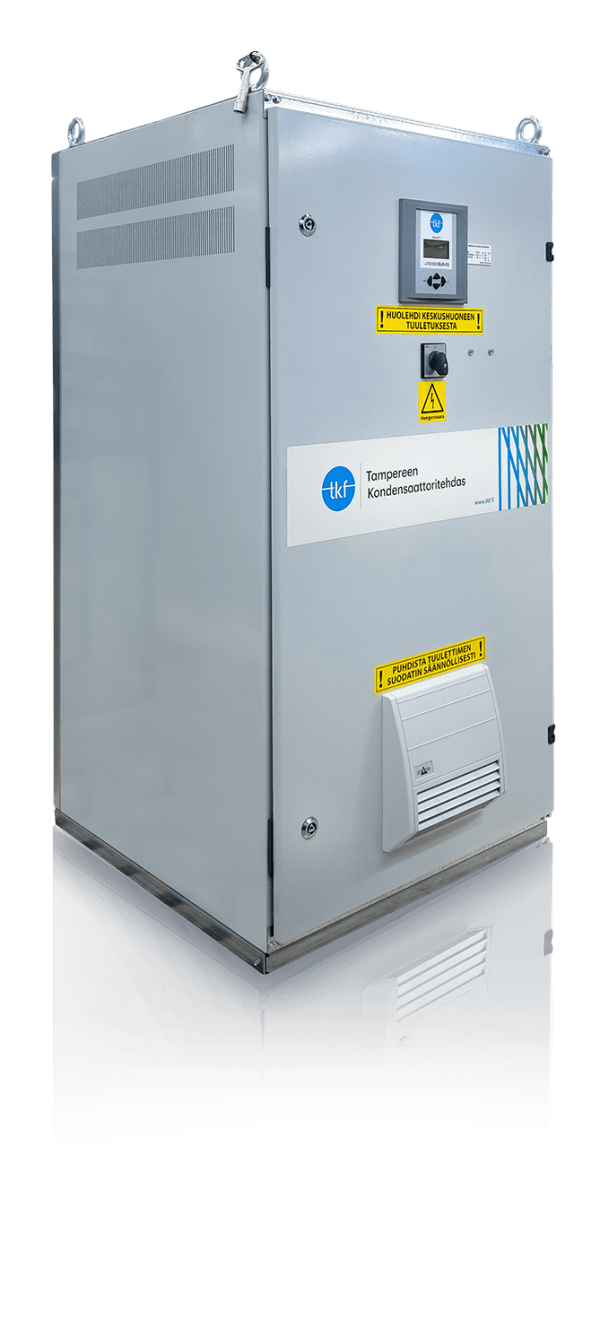
An inductive compensation bank consists of appropriate compensation stages, just like the more familiar detuned capacitor bank. Whereas the main component in a detuned capacity bank is a capacitor, the inductive compensation bank has a specially manufactured coil or reactor. A suitable combination of small (5 kvar), medium (10 kvar), and large (15 kvar) inductive compensation stages is selected for the inductive compensation bank. The compensation stages are controlled by a regulator that switches them on or off as needed at any given moment.
Typical inductive compensation banks
– TKF-I30/ 5+10+15 /400-50-189
– TKF-I40/5+2×10+15/400-50-189
– TKF-I60/5+10+3×15/400-50-189
– TKF-I75/ 5+10+4×15 /400-50-189
Features
– 400 V, 50 Hz
– 6-step control
– Cabinet dimensions: 800 x 600 x 2000 (L x W x H)
– Filter fan
– Enclosure rating IP30
– Indoor installation, 0–35°C
Options
– Voltage level other than 400 V, such as 690 V
– Outdoor installation: IP43, -25°C – (+35°C)
– Cable routing from the bottom or the side
– Slave battery without a controller
TKF's solutions are used at thousands of sites, ranging from office buildings to industrial facilities
Needs range from standard reactive power compensation to demanding applications that are critical to society. Hospitals (such as Tampere University Hospital and Satakunta Central Hospital in Finland), the Finnish Defence Forces, infrastructure projects (Helsinki Airport and the Helsinki metro), industry, real estate companies (VVO, Senate Properties), and electrical installations.