Static VAR Generator (SVG)
An SVG is designed for both inductive and capacitive reactive power compensation. The device operates with fully stepless control, so reactive power is always completely eliminated. For example, some electricity network operators do not provide reactive power for free at all. In these cases, the SVG handles compensation more efficiently than a traditional detuned capacitor bank or an inductive bank. It is easy to use thanks to the 4.3-inch touchscreen.
Features
- 400 V, 50 Hz
- Stepless adjustment
- Compensation of inductive and capacitive reactive power
- < 15-millisecond delay
- Power modules: 30 kVAr and 50 kVAr
- Device dimensions: 500 x 88 x 470 mm (W x D x H)
- 4.3-inch display
- Enclosure rating: IP20
- Weight: 24 kg
- Indoor installation: 0–35°C
- RS485 Communication
Options
- Ethernet
- Other IP classifications
- Outdoor installation: -10–35°C
Power quality
backup
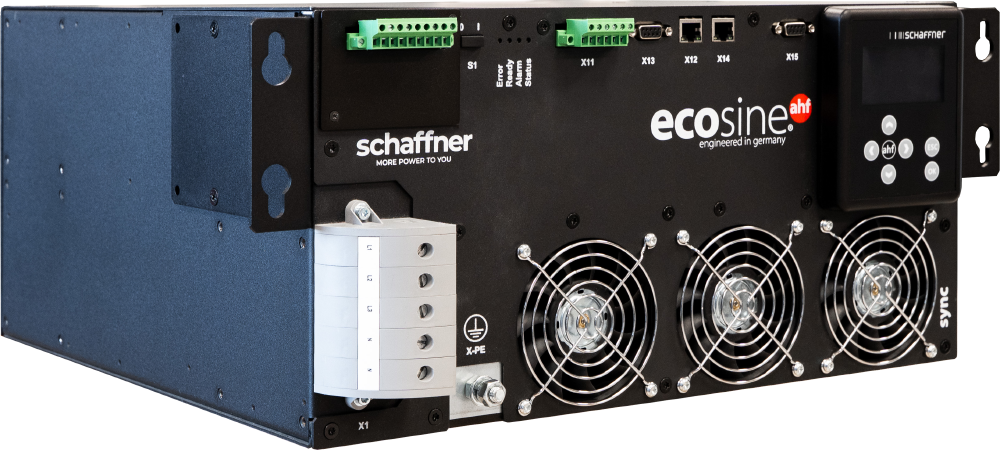
The active filter is designed for networks with high harmonic content to dynamically improve power quality. An active filter is a particularly effective solution when the network has harmonics of various orders (5th, 7th, 9th, 19th, etc). In addition, the harmonic levels may vary. An active filter produces a current opposite to each harmonic current, cancelling out the harmful harmonics. In addition, the active filter improves both the inductive and capacitive power factors. Any suspicion of high harmonic distortion should be verified through measurements.
Active filter
features
– Compensation current: 40–400 A
– The modular design also allows for compensation currents of over 400 A
– 3- or 4-wire version
– Voltage: 200–690 V
– 50/60 Hz
– Temperature: 40°C without a reduction in power; 55°C with reduced power
– Air- or water-cooled
– IP30, up to IP54 if necessary
Harmonics

Harmonic sources
Well-known sources of harmonics include frequency converters, switch-mode power supplies, thyristor switches, electronics in homes and offices, UPS systems, LED lights, and discharge lamps.
Disadvantages
The adverse effects of harmonics include increased interference in the network and in electricity users’ equipment, as well as a reduction in the load capacity of the equipment. Harmonics also cause meter readings to be inaccurate and lead to malfunctions in automation equipment and protective relays.
TKF's solutions are used at thousands of sites, ranging from office buildings to industrial facilities
Needs range from standard reactive power compensation to demanding applications that are critical to society. Hospitals (such as Tampere University Hospital and Satakunta Central Hospital in Finland), the Finnish Defence Forces, infrastructure projects (Helsinki Airport and the Helsinki metro), industry, real estate companies (VVO, Senate Properties), and electrical installations.